
The temperate rainforest valleys and mountain slopes of British Columbia are rich with ancient cedars and massive Sitka spruce trees. The Musqueam, Squamish, and Tsleil-Waututh nations have lived in what is now Vancouver for generations, among the more than 200 distinct First Nations who reside across British Columbia. Vancouver today has the third-largest urban Indigenous population in Canada. Vancouver's diverse ecosystems support an abundance of multi-city wildlife, including bald eagles and black bears that fish for salmon in local rivers, which I witnessed on one of my outings near the region. For this study I will be focusing on parks and forests in Vancouver with emphasis on Vancouver’s natural landscapes. Observing my surrounding and connecting with more than human beings through my painting and drawings, which keep me present in the moment. I want to use this study to help bring awareness as well to protecting and restoring green spaces and creating a connected network in attempt to preserve Vancouver’s environment for future generations.

Pacific Spirit Forest "Northern Flicker" Bird drawing and sound recording October 2024

Pacific Spirit Forest "Northern Flicker" Bird spotting. On a trip with my class I found this bird. My Merlin app verified it as a Northern Flicker. Usually found alone or in pairs, these birds can form larger, loose groups during migration and winter. They are often spotted foraging on the ground in open spaces, searching for ants and worms. They are quite vocal and noticeable.

Stanley park "Tree drawings" September 2024

Stanley park "Chicken of the forest" yummy mushrooms September 2024

Stanley park drawing of mushrooms seen on the walk. Mushrooms grow underground and only their heads pop out to spread pores. September 2024

Seymore Forest "Tree drawings" October 2024. Drawing in the moment. In this forest western and mountain hemlock, amabilis fir, western red-cedars and yellow‑cedar trees grow. Named after the Yellow-cedar also known as Yellow-cypress tree. Western white pine grows here, along with some Douglas‑fir.

Seymore forest, Salal is the left sketch, Western Red Cedar is the right, October 2024

During my trip to Seymore Forest, I encountered Salal (Gaultheria shallon) for the first time. This evergreen plant features clusters of bell-shaped pink or white flowers in spring, followed by edible blue-black berries. Salal can be used as a mixed border or ground cover and provides essential habitat and food for wildlife. they were a staple traditional food for northwest coastal peoples, who mashed and dried them into cakes and fruit leather for winter use

Geese at sunset from Queen Elizabeth park, talking to each other, October 18th 2024

Stanley Park baby squirrel in a hole, why are you hiding? September 2024
_edited.jpg)
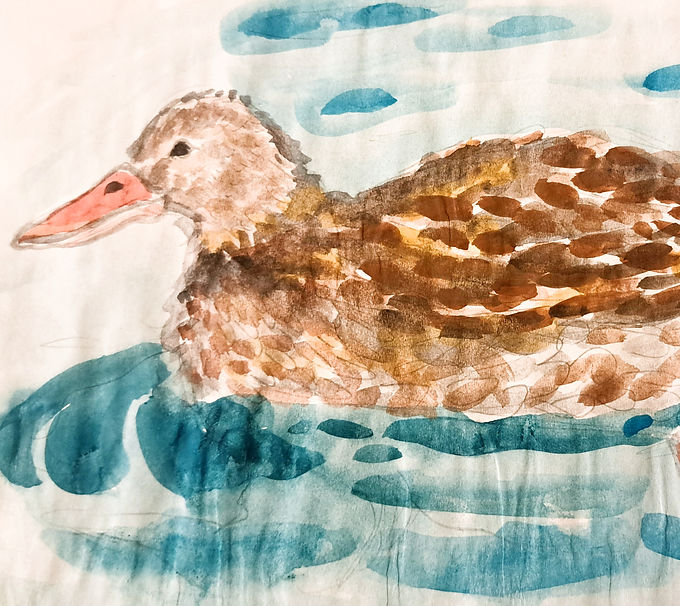
Queen Elizabeth Female Mallard duck swimming in the rain (online references used) Fun fact: most Mallard ducks live for one or two years, but some can live as long as 16 years. November 2024

Queen Elizabeth Male Mallard duck swimming in the rain (online references used) November 2024

From class trip to Seymore Forest, example of the lush mosses and lichens that grow on decaying woods and nursing logs. You can see several sword ferns peaking out from the underbush. Lush green from all the rain we get here. October 2024

I was crossing the street by King Edward skytrain station and saw a pigeon keeping warm behind a stalling vehicle. November 2024

My squirrel friends in the tree in front of my home has been collecting acorns preparing for the winter months. November 2024

Vine Maple and Douglas fur bark. Douglas Firs can withstand forest Fires. October 2024

Seymore Forest. Red Cedar, yellow cedar. Old growth trees accumulate knowledge on how to survive for 100s of years. October 2024
